
Just after six the air is still cold enough for a jacket. The engine hums, nothing else happens. A dune flank climbs away on your right, the line between light and shadow travels along with the car, and then a sign turns up at the roadside: 45. A few cars are parked in the sand beside it, and high on the crest small figures walk in single file. Almost every famous dune in this area sits along this one road.
So there are two groups. The dunes along the road stand right by the tar, Elim Dune five kilometres past Sesriem gate and Dune 45 at kilometre 45. The dunes at the pan lie at the very end, Big Daddy and Big Mama above Deadvlei. It is about 60 kilometres of tar to the 2x4 car park, then five kilometres of deep sand that need a real four wheel drive, or the shuttle.
- Tar road from Sesriem gate
- about 60 kmthen five kilometres of deep sand
- Highest dune
- 325 to 380 mBig Daddy, depending on the source
- Local type of dune
- Star duneswind from three or more directions
- Dunes with their own name
- fourElim, 45, Big Daddy, Big Mama
Why these dunes stay put
Closer to the coast the dunes travel. Wind there comes from a single direction, crescent dunes form, and they drift north with it. Further inland two wind directions meet, and long linear dunes are the result.
At Sossusvlei the wind arrives from three or more directions. No side wins. Sand is pushed against the same hill from everywhere, the dune grows several arms out of one central peak, and instead of moving it builds upwards. Star dunes are the tallest type of dune there is, and they are unusually stable. Some pass 300 metres. Where the sand came from and how old this desert is, you will find on the page about the making of the Namib.
- At the panBig Daddy
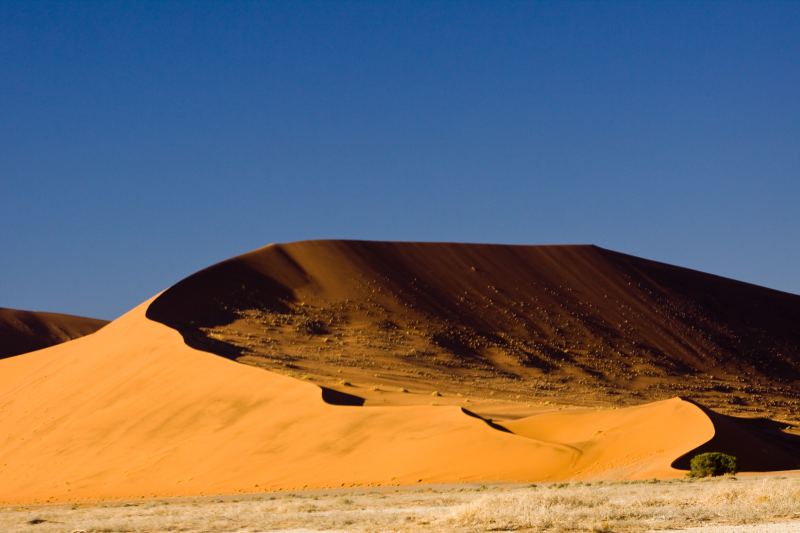
The highest dune at Sossusvlei, a good two hours up through soft sand, and a way down that takes ten minutes.
- At the panBig Mama
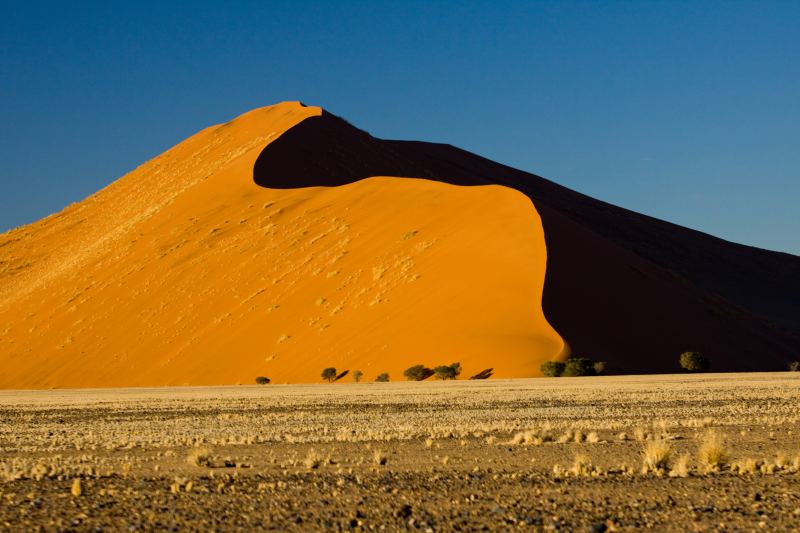
More than 200 metres high, just north of Big Daddy, and from the top Deadvlei lies right below you.
- Along the roadDune 45
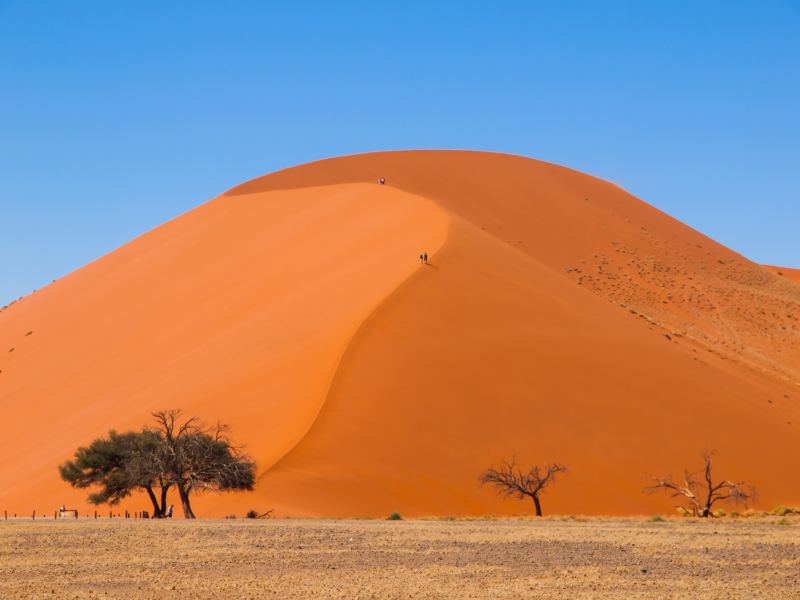
The most photographed dune in Namibia sits at kilometre 45 of the road. The climb takes 20 to 30 minutes, and the sources cannot agree on its height.
- Along the roadElim Dune
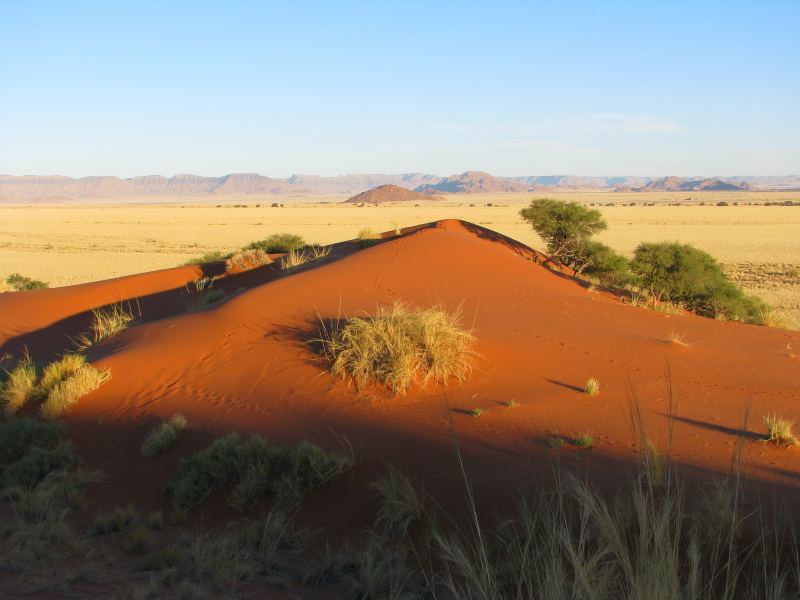
Around 100 metres high, five kilometres past Sesriem gate. The one dune you still reach in morning light if the outer gate only lets you in at sunrise.


Which dune suits which day
Short on time, through the gate late, no four wheel drive: Elim Dune. Five kilometres, around 100 metres high, and because the outer gate at Sesriem opens at sunrise, it is the only dune you still reach in morning light afterwards. If you sleep outside the gate, sunrise leaves you with this one option.
If you would rather not climb at all, stay at the bottom of Dune 45. The familiar picture, the curving crest with the camel thorn trees in front of it, is taken from the foot of the dune right beside the road. And if you do want to go up: 20 to 30 minutes, and the climb counts as easy.
The one big effort is Big Daddy. One and a half to two hours through soft sand, the view over Deadvlei and the dune fields behind it, and then a descent down the steep face that takes ten minutes. It costs you half a morning and asks for some fitness.
Big Mama sits in between. More than 200 metres, north of Big Daddy, the same pan from a different angle. Both are reached only across the last five kilometres of deep sand.
What the climb actually asks of you
Sand gives way. Every step slides back a little, far more on the open flank than up on the crest, which is why everyone walks the crest. Up there the wind has packed the sand harder. The line between light and shadow shows you the route, and all you do is follow it.
There is no shade on any of these dunes. No tree, no rock, nothing. From late morning the sand heats you from below and the sun from above, and any climb turns into a bad idea. Two litres of water per person is the minimum once you are heading up for more than half an hour.

NoteThe outer gate at Sesriem opens at sunrise and closes at sunset. The inner gate to the Sossusvlei road opens an hour earlier and closes an hour later, which only helps you as a guest staying inside the gate, at Sesriem Campsite, Sossus Dune Lodge or Dead Valley Lodge.
Frequently asked questions
Which dunes at Sossusvlei can you climb?
Four dunes at Sossusvlei are set up for visitors: Elim Dune five kilometres past Sesriem gate, Dune 45 at kilometre 45 of the road, and Big Daddy and Big Mama above Deadvlei. All four are open without a guide and are covered by the park entry fee.
Why do the dunes at Sossusvlei have numbers?
The numbers on the dunes along the road from Sesriem to Sossusvlei give the road kilometre the dune stands at. Dune 45 carries that name because it sits at kilometre 45 of the road.
Why do the dunes at Sossusvlei not move?
The big dunes at Sossusvlei are star dunes: wind reaches them from three or more directions, so they grow upwards instead of travelling in one direction. Crescent dunes closer to the coast do move, drifting north with the prevailing wind.
Do you need a four wheel drive for the dunes at Sossusvlei?
Any rental car reaches Elim Dune and Dune 45, because the road from Sesriem gate is tarred for around 60 kilometres. Only the final five kilometres to Big Daddy and Big Mama at Deadvlei are deep sand and call for a proper four wheel drive or the shuttle.
When should you climb a dune at Sossusvlei?
Early morning is what counts for climbing the dunes at Sossusvlei. Right after sunrise the sand is still cool, from late morning on it turns too hot, and none of these dunes offers any shade.