
Your first step onto the pan sounds like a step across an empty attic. The clay is rock hard and so bright that you squint, even with the sun still low. Dry cracks run across the whole surface in hexagons, and when you tread on a curled edge it snaps away like thin porcelain.
The heat comes back at you from below before it has properly started from above. By eight in the morning it is already inside your shoes. Four such pans lie at the end of the Sossusvlei road, two that everybody knows and two you can only reach on foot.
- Pans in the area
- fourSossusvlei, Deadvlei, Hiddenvlei, Naravlei
- Floor
- clay and calcretehard, pale, broken into plates
- Tsauchab
- 150 kmfrom its source to the pan at Sossusvlei
- Water in the pan
- roughly every ten yearsdocumented floods in 1997, 2000, 2006, 2011, 2022
- On foot to Deadvlei
- a good 1 km10 to 20 minutes, no shade
What a vlei actually is
Vlei is Afrikaans for a shallow hollow that collects water whenever water arrives. After heavy rain a shallow lake stands in it. The lake evaporates again, and what the river brought stays behind: fine clay and calcrete, layer upon layer, over a very long time.
That is why nothing grows in the pans. The clay compacts as it dries, the calcrete below it is dense enough to stop roots getting through, and salt does the rest. What you see at Deadvlei is not soil that was once fertile, it is the sediment of a river that no longer comes.
Along the edges, where sand and clay mix, single camel thorn trees and tufts of grass hang on. Two steps further out, in the middle of the surface: nothing.

The Tsauchab and whether it ever arrives
The Tsauchab rises in the Naukluft mountains, cuts Sesriem Canyon after about 80 kilometres and then runs into the sand sea. After roughly 150 kilometres it stops. The Atlantic is still 52 kilometres away in a straight line, a distance the river never covers: only 60 per cent of its catchment gets more than 100 millimetres of rain a year, and sand and evaporation take the rest.
In most years it soaks away long before the pan. Documented flood years are 1997, 2000, 2006, 2011 and 2022, and one source offers a rule of thumb of one event about every ten years. How long the water then stands is disputed: figures range from four weeks to 18 months, depending on the source and probably on the strength of the flood.
The dunes cut off the river long before the first visitor stood here. How the sand sea formed and why it pushes so far east at exactly this spot is covered under how the Namib came to be.
- By the car parkDeadvlei
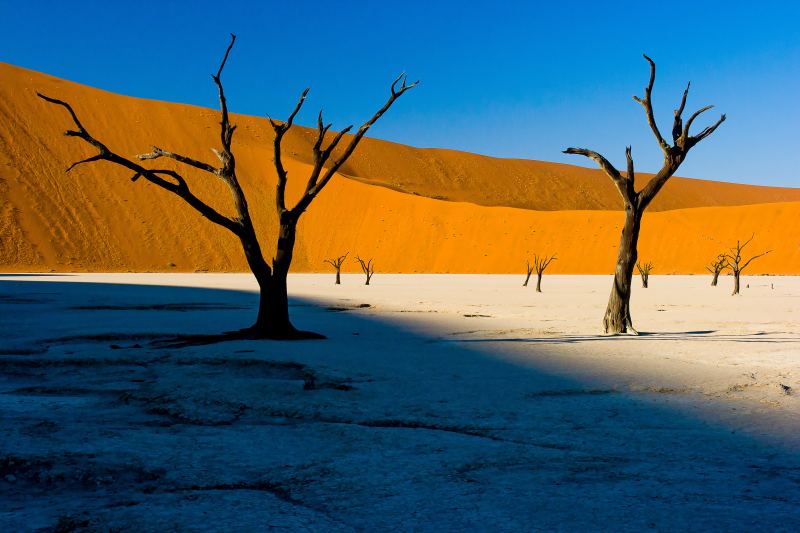
The white clay pan with the dead camel thorn trees, a good kilometre on foot from the car park.
- By the car parkSossusvlei

The end of the Tsauchab, some 150 kilometres after it starts in the Naukluft mountains.
- Off the pathHiddenvlei
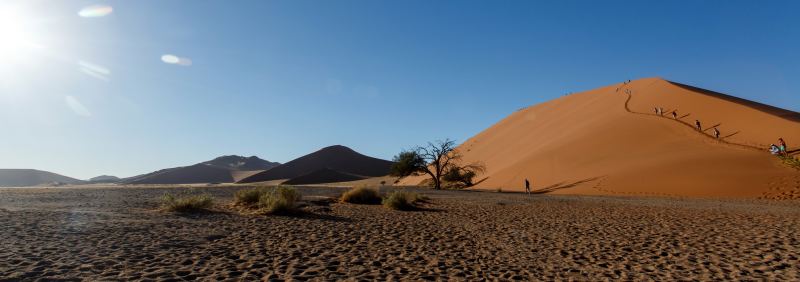
The least visited of the four pans, about four kilometres from Sossusvlei.
- Off the pathNaravlei
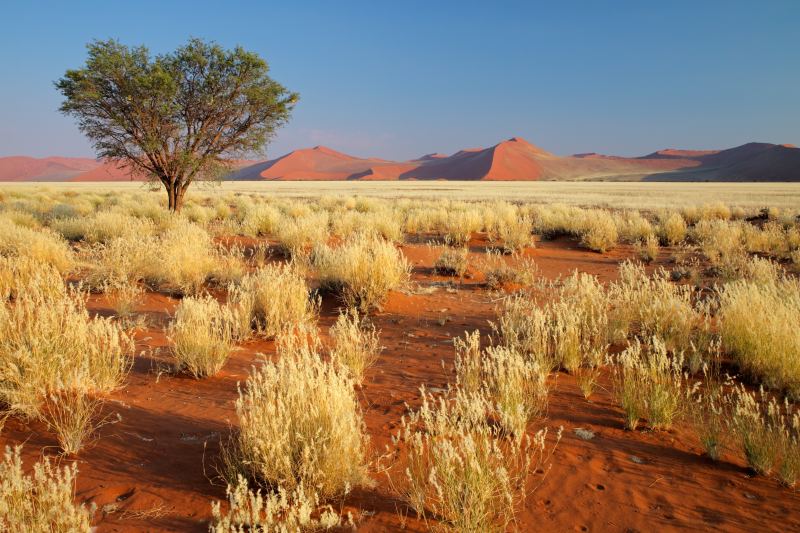
The pan next to Sossusvlei, named after the nara melon growing along its edge.


The four in a single morning
Here is the order that works: leave as the gate opens, 60 kilometres of tar to the 2x4 car park, then five kilometres of deep sand. From the car park walk into Deadvlei first, because in that first hour the dune shadow still covers the pan and the clay is cool. Then a few minutes by car to the pan at Sossusvlei. Naravlei sits right beside it and half an hour is enough.
Hiddenvlei does not fit into that morning. About four kilometres from Sossusvlei, marked with white posts, without any shade. If you want to go, take the late afternoon or a second day.
People turn back earlier than they planned. The walk into Deadvlei is a good kilometre over low dunes, so 10 to 20 minutes going in. Coming back through soft sand, sun above and heat below, takes longer. From about nine the sand is too hot for bare feet, and if you leave the car park at ten you tend to get one look at Deadvlei and then the walk back.
Our tipWear closed shoes even if others set off barefoot. The clay of the pans has sharp edges, and the sand between them gets too hot to stand still on from nine in the morning. Two litres of water per person belong in the bag, because none of the four routes has any shade.
Frequently asked questions
What is a vlei?
A vlei is a shallow hollow that collects water whenever water arrives. At Sossusvlei the floor of these pans is clay and calcrete, so almost nothing grows on them, and the surface breaks into hard plates as it dries.
How many vleis are there at Sossusvlei?
Four pans at the end of the Sossusvlei road carry a name: Sossusvlei itself, Deadvlei, Hiddenvlei and Naravlei. Deadvlei and the pan at Sossusvlei sit close to the car park, while Hiddenvlei and Naravlei are reached on foot and usually without other visitors.
Can you see all the vleis in one morning?
Deadvlei and the pan at Sossusvlei fit comfortably into one morning, and Naravlei adds about half an hour. Hiddenvlei lies some four kilometres off and needs half a day of its own, best in the late afternoon.
Why does nothing grow in the vleis?
The floor of the pans at Sossusvlei is fine clay over a thick layer of calcrete. Water barely soaks in, roots cannot get through the calcrete, and what remains is a hard salty surface where no plant holds on.